Date: 01/04–01/08/2023
Project Showcase
Link to the original project: https://immersivenetworks.co.uk/thekingsbook/
My role in this project was observing the project design process, interview facilitation and post-experimental data collection. I also participated in the experiment. This reflective diary is based on my experience and data collection outcome.
Reflective Diary
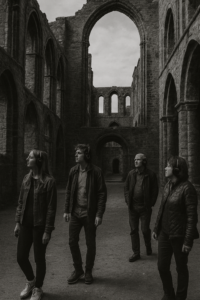
I was invited to collaborate with immersive artist Dave Lynch on an audio-driven locative narrative project, The King’s Book (https://immersivenetworks.co.uk/thekingsbook/), set within the ruins of Kirkstall Abbey in Leeds. Although I was not directly involved in sound production, my responsibilities included co-designing questionnaires, recruiting and guiding participants, and conducting part of the post-experience interviews. I also experienced the project firsthand as a participant, which was amazing.
The project invited visitors to freely explore the abbey ruins while listening to spatialised sound and stories on the Echoes app. The app uses phone GPS to trigger audio stories when a user carries the phone and moves through the sound map (see details on The King’s Book website). The experience shows a fictional narrative set in the 1530s, unfolding through a blend of ambient soundscapes, monastic chants, and dramatic voice-overs. As Slater and Sanchez-Vives (2016) describe, immersive presence requires a fusion of sensory, narrative, and spatial cues, and this work shows me exactly how that triadic structure works. Interestingly, the visual aspects of the site were minimal as Kirkstall Abbey remained in its ruined state, with no digital visual overlays. Instead, all storytelling was carried only by sound.
During my own visit, I felt more like a “monk” than a researcher. One moment that stood out vividly was when I was standing in the yard outside the nave (outdoor) with my eyes closed, enveloped by layers of chanting in the choir on my left side and distant thunder behind me. Maybe it was a digital “auralization” (Pentcheva & Abel, 2017). This article discusses the concept of auralization using the Icons of Sound project (Pentcheva & Abel, 2017) as an example. It was a realistic and deeply effective experience, helping me to understand the ruin with spatial sound. At the end of the experience, it triggered me to think: is it possible for me to use sound to recreate the lost industrial heritages in online museums with low-cost technologies and if so, how? I carried on exploring this in future practices.
The King’s Book had multicultural background participants, and many expressed similar feelings to mine. In post-experience interviews and questionnaires, they reported feeling a sense of historical presence and emotional resonance even without explicit visual cues. One participant who attended both The King’s Book and my later research (practice 10) told me about her experience with an exhibition in London about Christianity through visual effects (like dynamic lighting on marble sculptures) and religious background music she attended after The King’s Book. Both projects attempted to create emotional resonance with a religious scenario, but as a non-Christian, she did not feel any emotional connection, even though she heard other Christian participants comment, “It was so moving, it brought me to tears”. However, interestingly, she deeply felt an emotional connection with The King’s Book, and this became one of the reasons she continued to explore and still remembered some of its scenes later (in late September 2025, two years after the experiment ended). She believed that sounds that could be related to real-life scenes were crucial factors in establishing her sense of immersion. Even though the visual environment was a ruin, she still felt she had been transported to a place with a prosperous, lively atmosphere with many monks.
Most participants agreed that “the feeling of being there is amazing” in the interview and that the narrative form of sound created this engaging experience. However, because the continuity of the narrative was highly important in this exhibition, one participant commented on the second chapter of the tour, “If you don’t know the relevant background in advance, you will be confused about this place.” Furthermore, technology also became an obstacle to this continuity, as the tour used beacons activated by the GPS on participants’ phones, but both the GPS and beacon sensors have slight inaccuracies. Therefore, some participants failed to activate the audio for certain chapters during the tour, causing them to feel lost. In fact, half of the participants felt that “technology gets in the way during the experience”. However, in terms of the overall experience, 70% of participants felt some varying degrees of immersion, and the speed at which they became immersed, driven by the sound, was generally fast. Furthermore, 70% of participants felt the amount of sound effects provided was “enough” or “exceeded expectations” in creating a sense of place, while 20% felt there “could be more,” and 10% felt it was “not enough.“ What was very interesting was that after the exhibition, almost all participants did not want to “become a monk,” even if they felt they were one during the tour.
When comparing the physical exhibition environment of the industrial museum with the ruins of the Abbey, it can be observed that the visual environment and dynamics available to participants are limited in both cases. The Abbey is left with only remnants and ruins, while the machines in the museum have mostly been moved from their original working environments to be maintained and exhibited in the context of a museum. Since sound can bring an understanding of a story from a narrative perspective, can an understanding of an industrial environment be brought about by recreating the sounds of its working environment? This is important for my future practices.
Reflective Methodological Note
In this project, I found myself simultaneously a listener, facilitator, and methodological observer. This experience taught me that sound is not merely a supplement, but it can form the structural foundation of a multisensory, historically resonant environment. But to achieve this, the listener must be actively engaged with the space, emotion, and story.
The King’s Book also revealed the limitations of visual dominance in heritage communication. At Kirkstall, the absence of full architectural reconstruction forced participants to use sound, memory, and imagination to fill in the gaps. This prompted me to reflect on how virtual museum designers might strategically collect/provide visual information to stimulate greater embodied engagement.
What became especially valuable for my ongoing research was how The King’s Book served as a prototype for investigating the capacity of sound to sustain interpretive structure in the absence of visuals. I began to treat the project not only as an artwork but as a test environment under a real-world simulation of what it might mean to “curate through sound”. Although I had no authorial control over this design, I found it critical to observe how orientation, attention, and emotion were achieved through sonic sequencing alone. These insights became foundational for the audio-only experiments I would later construct, where the listener’s imagination was the central stage of activation, rather than relying on screens and visuals.
Moreover, the success of the soundscape not only lies in its clarity or fidelity but in its ambiguity and layering. Participants did not merely receive sound, but they oriented toward it, imagined the environment around it, and moved their bodies within it, becoming part of the narrative. As Bushara, Grafman and Hallett (2001) have noted, when auditory cues guide visual interpretation, the brain constructs presence differently, and sometimes even more vividly.
This raises deeper questions about the attribution of time: when we hear historical sounds in today’s ruins, are we resurrecting the past, or are we creating something entirely new? This is something worthy of deeper exploration, too. I learned from this research that if immersion is an embodied speculation, then sound is its language.
Reference
Bushara, K.O., Grafman, J., & Hallett, M. 2001. Neural correlates of auditory-visual stimulus onset asynchrony detection. Cognitive Brain Research. [Online]. 11(3), pp. 237–245. [Accessed 28 April 2025]. Available from: https://doi.org/10.1523/JNEUROSCI.21-01-00300.2001
Kätsyri, J., Förger, K., Mäkäräinen, M., & Takala, T. 2015. A review of empirical evidence on different uncanny valley hypotheses: Support for perceptual mismatch as one road to the valley of eeriness. Frontiers in Psychology. [Online]. 6, pp.390. [Accessed 28 April 2025]. Available from: https://doi.org/10.3389/fpsyg.2015.00390
Pentcheva, B.V. and Abel, J.S. 2017. Icons of sound: auralizing the lost voice of Hagia Sophia. Speculum. [Online]. 92(S1), pp.S336-S360. [Accessed 28 April 2025]. Available from: https://www.journals.uchicago.edu/doi/full/10.1086/693439
Slater, M., & Sanchez-Vives, M.V. 2016. Enhancing Our Lives with Immersive Virtual Reality. Frontiers in Robotics and AI. [Online]. 3(74), pp. 1–47. [Accessed 28 April 2025]. Available from: https://doi.org/10.3389/frobt.2016.00074