Date: 26/10/2023-06/03/2024
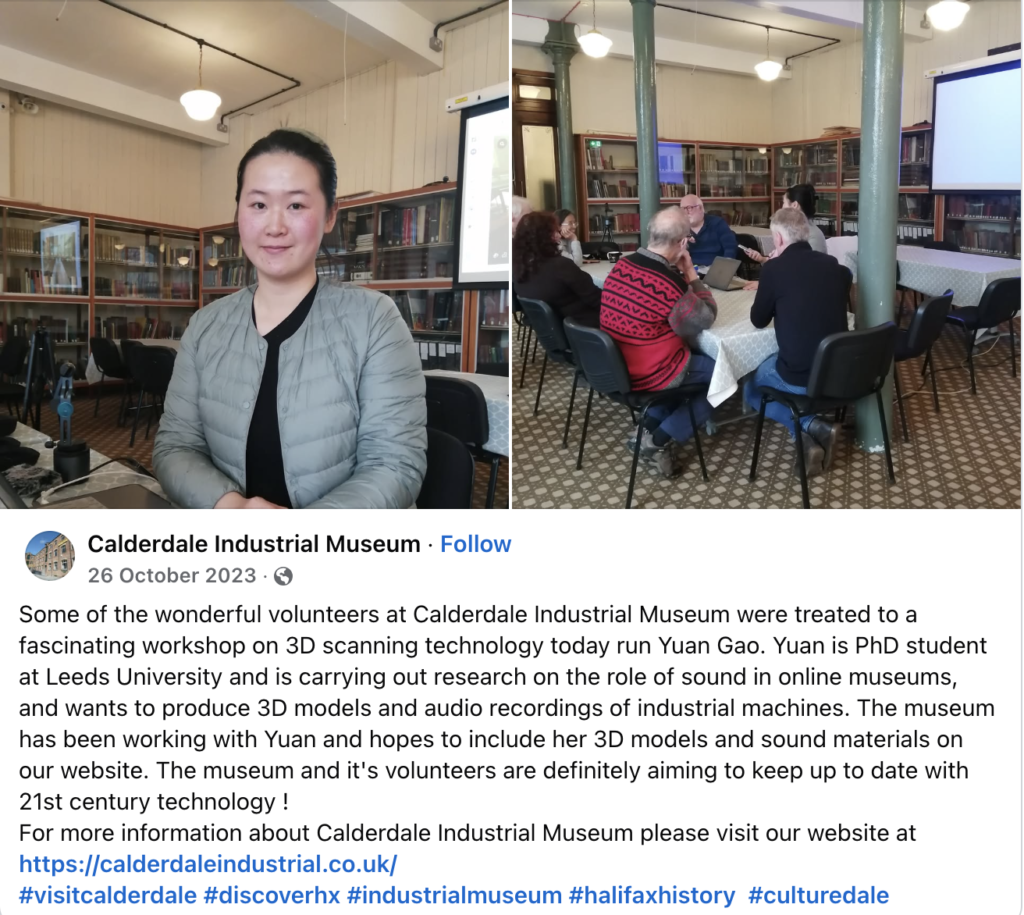
Workshop Material Showcase
Workshop Slides
Level 1 workshop:
Level 2 workshop does not have slides.
Participants’ Works
3D Scans:
Scanned using Scaniverse
Scanned using Polycam
Audio recordings:
For a better experience, listening with binaural earphones is preferred.
Participants also made a Matterport scan; however, because the scan includes participants’ faces, it is not presented here to keep the participants’ identities anonymised.
Anonymised workshop interview recording
Workshop Interview Transcripts‘ Highlights Example from level 1 workshop (Generated with Otter, data used was anonymised transcription)
Challenges in 3D Modelling and Photography
- Speaker 2 discusses the museum’s goal to put their collection online in 3D models, highlighting issues like immovable machines and reflective surfaces that distort images.
- Speaker 3 proposes removing guards from machines to get better 3D models, emphasising the importance of seeing the machine’s internal workings.
- Speaker 6 mentions using 3D models for restoration and refurbishing, noting that 3D models can help in reassembling machines and measuring parts accurately.
Accuracy and Limitations of 3D Scanning
- Speaker 3 emphasises the importance of having accurate measurements and dimensions for refurbishing equipment, even if the scans are not perfect.
- Speaker 2 and Speaker 3 discuss the potential of using 3D models and immersive technology to enhance museum tours and provide more detailed information.
Immersive Technology and Virtual Reality
- Speaker 2 and Speaker 3 discuss the potential of using immersive technology to create more engaging museum tours, including linking historical videos to exhibits.
- Speaker 4 and Speaker 3 discuss the balance between providing enough information online to attract visitors while encouraging them to visit the museum in person.
Copyright and Ownership of Digital Content
- Speaker 5 and Speaker 2 discuss the ownership of copyright, suggesting it belongs to the person who takes the model or the software company.
- Speaker 6 mentions the possibility of agreements between the museum and creators to determine copyright ownership.
- Speaker 1 and Speaker 2 discuss the challenges of copyright in the context of advanced technologies and the need for clear agreements.
Monetising Online Museum Experiences
- Speaker 2 and Speaker 8 discuss the possibility of offering free access to a limited portion of the museum online and charging for additional content.
- Speaker 6 suggests using membership models to provide access to more content and encourage donations.
- Speaker 1 and Speaker 2 discuss the importance of regularly updating online content to keep visitors engaged and encourage repeat visits.
Sound and Ambience in Online Museums
- Speaker 4 mentions the need for more equipment to make noise and the potential of using recordings of historical sounds.
- Speaker 3 emphasises the importance of sound in creating an immersive experience, comparing it to watching a football match without sound.
- Speaker 6 suggests using volunteers to provide explanations and add to the ambience of the online museum experience.
Balancing Online and Offline Experiences
- Speaker 4 and Speaker 8 discuss the challenge of distinguishing between people who cannot visit the museum and those who choose not to.
- Speaker 2 and Speaker 4 discuss the potential of using online content to encourage donations and support the museum’s operations.
- Speaker 1 and Speaker 4 emphasise the importance of providing a unique experience both online and offline to attract and engage visitors.
Marketing and Advertising Strategies
- Speaker 2 and Speaker 4 discuss the importance of marketing and advertising to attract visitors and support the museum’s operations.
- Speaker 3 suggests using dynamic content to keep visitors engaged and encourage repeat visits.
- Speaker 6 mentions the potential of using QR codes to link online content to physical exhibits and encourage visitors to explore more.
- Speaker 1 and Speaker 2 discuss the importance of regular updates and new content to keep the museum’s online presence fresh and engaging.
An example of data analysis can be found here: https://docs.google.com/document/d/1y7vN6FIqFdE6CNo0QDGjg_7pn4CdKXplOQvqSjxKIw4/edit?usp=sharing
Reflective Diary
After testing various digital tools at the Calderdale Industrial Museum (CIM), I proposed to the museum’s management team that I would like to expand the project into a form of co-learning: a series of interactive workshops for volunteers and staff exploring how 3D scanning, spatial audio, and platforms like Matterport could be integrated into their own exhibition planning. Also, I aimed to use workshops as a medium to help museum volunteers know more about digital technologies because many of them have been retired from industries for a long time. Thus, these workshops had a dual purpose. Firstly, to introduce participants to technologies. Secondly, to encourage them to reflect on how digital media reshapes curatorial identity, documentation practices, and visitor experience.
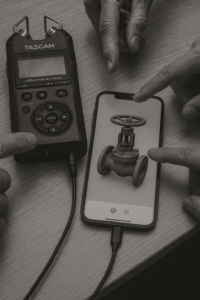
I provided two levels of workshops. The first level focused on introducing the basic functions of consumer-grade tools, such as how iPhone-based LiDAR works (like our eyes) with 3D scanning apps (like our brains) to create a model. This could be helpful to level participants’ knowledge of technology and boost their confidence to explore digital technologies in the practical section of the workshop, based on what they would like to know more about, as most participants had little to no prior exposure to such technologies. The second level built on the previous workshop and guided attendees through basic data processing tasks, such as editing scan outputs, reviewing audio, and embedding results into the Matterport model they created in the workshop.
Across both levels, over 10 participants engaged (some intermittently), including both long-term museum volunteers and younger external attendees. I provided all the necessary equipment that I explored in my previous practices, made sure every group could access them, and explained to them how to use the different pieces of equipment step by step. The atmosphere was informal and purposeful because participants brought not just curiosity into these workshops but also their questions, anxieties, and expectations.
One of my goals in designing the workshops was not to give one-directional spoon-feeding teaching or treat participants as passive recipients of technical knowledge, but to use them as a co-learning opportunity. Drawing from the logic of participatory research (see image 4 of my research thesis for details), I invited participants to test, critique, and reimagine the tools we were using. This practice is not just about asking how these technologies work, but how they should be used, and how they trigger museum practitioners to reflect on technology usage. This structure emerged not from pedagogical idealism, because that is not something this research looks at, but from necessity. The museum’s volunteers came from diverse backgrounds (e.g. engineers, artists, educators, retirees) and brought different literacies (e.g. the majority of them worked in industries and have an emotional connection with machines, and working on preserving industrial history), expectations (e.g. to develop the museum, and gain knowledge about technologies), and emotional registers (e.g. one participant “disliked technologies”, and some are curious) into the room. As a result, the workshop I provided became a space of dialogue where the act of scanning or recording often led to unexpected ethical or political conversations.
I tried to avoid treating output quality as the primary benchmark for success. Instead, I encouraged participants to focus on the process. I attempted to know and observe what made them feel intuitive, what was frustrating, and what they wanted to improve. I see these workshops as reflective laboratories rather than training spaces. In some moments, this meant embracing failure. When Polycam crashed or a sound file went missing, we discussed what that revealed. It is not just about the tool, but about our assumptions of control. When I reviewed this practice, I found it amazing, because this alignment between technical practice and critical reflection subtly impacts my later practice frame, as a practice–critique–practice iterative loop, which means each hands-on segment fed into interpretive dialogue, and each conversation informed how the next task was approached.
Some conversations left a lasting impression. One volunteer highlighted the difficulty of scanning dark, glossy machine surfaces, a key limitation frequently emphasised in 3D scanning literature (Balado et al., 2024; Umezu et al., 2023). I suggested technical solutions like applying matte sprays, but they reminded me that such interventions are ethically problematic in heritage contexts. One participant said to me that “These aren’t props, they’re stories. You can’t just repaint them for convenience”, and other participants agreed.
Another participant, an engineer with decades of practical experience, became fascinated by the idea of recording procedural knowledge through sound. He said, “People don’t just want to hear the machines, they want to hear how they were used, how they sound when they’re right or wrong”. This is directly linked to the video I found on Chinese social media that I have mentioned in practice 3 (http://xhslink.com/o/4zSKMPV3vdg). This insight guided the discussion to not just be object-centred, which is focused on knowing what machines and technologies are, but also process-oriented, to know how they lived.
Participants also discussed the potential of 3D models for measurement, suggesting that scanned exhibits could be virtually disassembled and reconstructed for educational purposes. For me, this is a big change before and after attending the workshop. Although some of them were concerned about accuracy compared to manual documentation, there was general agreement that the trade-offs in accessibility and reusability were worthwhile.
I have come to fully understand the perspective of small and medium-sized museums, including both their positive outlooks and their concerns regarding the use of technology for online exhibitions. In my view, these concerns are to be expected.
This is because, against the backdrop of the pandemic and the Fourth Industrial Revolution (Schwab, 2017) (also called the Digital Revolution nowadays), and driven by the practices, showcases, and promotions of large museums and institutions (such as the British Museum and Google Arts & Culture), the museum sector has been inevitably swept into the torrent of digitisation. For those with insufficient funding, personnel, and training, digital technology appears more like a black hole that absorbs all costs.
Through dialogue, I can feel that what is important to small and medium-sized museums is not how to project themselves onto the international stage, but rather how to establish localised cultural spaces that provide participants with an environment for social interaction, experience, and embodiment (which echoes by participants’ feedback in practice 10, makes me believe many offline museums have achieved it). Therefore, the concerns that small museums have mentioned in the workshop (such as whether physical museums will be replaced, and the meaning, benefits, and drawbacks of the digital replicas that constitute online museums) have been carried on and explored in Practice Log 10 with participants (museum visitors), to provide more information from visitors’ perspectives for SMMs to make decisions on the creation of future online museums.
Reflective Methodological Note
In these workshops, my role evolved once again, which is from technical demonstrator to co-learner, translator (in many ways, e.g. observing participants’ acts/reactions, teaching them knowledge from my previous practices, etc.), and critical dialogue partner. I tested how small/local museum professionals engage with the capabilities and limitations of digital heritage in real-world contexts.
The key outcome of the workshops was not that participants could successfully use tools to digitise objects, sounds and spaces, but the conversations they sparked. Volunteers’ reflections challenged my assumptions about what “accessibility” truly means. It is not only about lowering technical barriers, but also about respecting existing values, knowledge systems, and sensory priorities.
Technologies like 3D scanning and spatial audio are often marketed as solutions, but their success in museums depends on how people interpret, redesign, and even resist them. As Sarah Pink et al. (2022) remind us, heritage technologies do not operate in a vacuum, but they enter worlds entangled with care, maintenance, and ethical judgment. These workshops demonstrated that some curators are less interested in flawless models and more interested in how models can help them tell stories, preserve memories, or transmit knowledge across generations.
From this practice, I saw how technical practice could become curatorial reflection (e.g. the reflective conversation we had when people with different roles and backgrounds sit together to discuss how to use technology to develop the museum and share concerns). I also learned that participatory interaction is not just about inclusion, but also acts as a critical method for this research.
Reference
Balado, J., Garozzo, R., Winiwarter, L. and Tilon, S. 2024. A systematic literature review of low-cost 3D mapping solutions. Information Fusion. [Online]. 14(article no. 102656) [no pagination]. [Accessed 28 April 2025]. Available from: https://doi.org/10.1016/j.inffus.2024.102656
Pink, S., Ruckenstein, M., Berg, M. and Lupton, D. 2022. Everyday automation: Experiencing and Anticipating Emerging Technologies. London and New York: Routledge.
Umezu, N., Koizumi, S., Nakagawa, K. and Nishida, S. 2023. Potential of Low-Cost Light Detection and Ranging (LiDAR) Sensors: Case Studies for Enhancing Visitor Experience at a Science Museum. Electronics. [Online]. 12(15), p.3351. [Accessed 28 April 2025]. Available from: https://doi.org/10.3390/electronics12153351
Schwab, K. 2017. The Fourth Industrial Revolution. Great Britain: Portfolio.